Abstract
This study examined the lived experiences and perceptions surrounding housemaids in Lusaka Province, Zambia, using a qualitative interpretivist approach with 45 participants, including employers, spouses, and housemaids themselves. Findings reveal that housemaids are widely perceived as lacking initiative, unproductive, and burdensome, which aligns with entrenched occupational stigma. Narratives further exposed recurrent themes of dehumanisation, including low wages, absence of contracts, denial of career prospects, physical and emotional abuse, and sexual exploitation. Employers frequently reinforced negative stereotypes, while housemaids recounted enduring inhumane working conditions, mistrust, and social exclusion. The study advances the Dehumanised Theory, which grounds how domestic workers are devalued not due to ethnicity or ideology, but because of the job they perform, rendering them “less than human.” This study recommendes the formalisation and professionalisation of domestic work through accredited training under TEVETA, enforceable written contracts, mobile-friendly abuse reporting mechanisms, and the extension of legal protections to both trained and untrained housemaids. These measures would restore dignity, promote empowerment, and address systemic silencing within this occupational domain.
Keywords
House-maids/House-helpers/Domestic Workers, Madam, Human Wellbeing, Work, Employee/Employer
1. Introduction
In urban Zambia, particularly in households ranging from middle income to the wealthiest, it is common to have individuals assisting with various domestic tasks, childcare, and related responsibilities. These workers are referred to by different titles, including 'housemaids'
| [2] | Banda, B. M., (2018). Maids Training Curriculum and Infant Care in Lusaka Urban, Zambia. International Journal of Humanities and Social Science Vol. 8 No. 4 April 2018 |
[2]
, 'domestic workers'
| [18] | Kelman, H. C. (1976). The Policy Context of Torture: A Social-Psychological Analysis. International Review of the Red Cross, 16(157), 26-34. |
| [11] | Hoerder, D. (2015). Historical Perspectives on Domestic and Care-Giving Workers’ Migrations: A Global Approach. In E. van Nederveen Meerkerk, S. Neunsinger & D. Hoerder (Eds.), Towards a Global History of Domestic and Caregiving Workers (pp. 61-109). Leiden/Boston: Brill.
https://doi.org/10.1163/9789004280144_004 |
[18, 11]
, and 'house-helpers'
| [32] | Sovon, S. I,. (2021). Protection of Domestic Workers: Need for Law. University of Asia Pacific. |
| [25] | Muasya, G. (2020). Stressors and work-family conflict among female teachers in urban public schools in Kenya. South African Journal of Education, 40(2), Article 1769. |
[32, 25]
. Despite the varied terminology, the core meaning and job description remain consistent, as observed by
| [29] | Smt. Sandhya S. J., (2019). A study on socio-economic status of house maid workers in Karnataka: A Sociological Study. International Journal of Management Studies and Social Science Research. IJMSSSR 2019 VOLUME 1 ISSUE 6 NOVEMBER - DECEMBER ISSN: 2582-0265/ Avai. |
[29]
. The term 'house-maid' may evoke an outdated concept not entirely suitable for contemporary times. However, 'maids,' a shortened form of 'house-maids,' is the more commonly used term in this context. In this paper, these three terms will be used interchangeably to denote the same type of worker. These workers typically engage in household tasks characterized by their diffuse, home-based nature, which often involves daily repetitive work.
| [29] | Smt. Sandhya S. J., (2019). A study on socio-economic status of house maid workers in Karnataka: A Sociological Study. International Journal of Management Studies and Social Science Research. IJMSSSR 2019 VOLUME 1 ISSUE 6 NOVEMBER - DECEMBER ISSN: 2582-0265/ Avai. |
[29]
.
So, who exactly is this worker with different titles? The International Labour Organisation (ILO)
defines 'domestic work' as "work performed in or for a household or households." The ILO committee, during a convention on domestic workers, further elaborated that a 'domestic worker' is "any person engaged in domestic work within an employment relationship." At the same convention, it was clarified that an individual who performs domestic work sporadically and not on an occupational basis does not qualify as a domestic worker. In the context of this paper, the term 'house-maid' refers to an individual employed to work within a domestic environment, primarily responsible for various domestic tasks. These tasks encompass general housekeeping and maintenance, childcare, and personal care
, and
| [29] | Smt. Sandhya S. J., (2019). A study on socio-economic status of house maid workers in Karnataka: A Sociological Study. International Journal of Management Studies and Social Science Research. IJMSSSR 2019 VOLUME 1 ISSUE 6 NOVEMBER - DECEMBER ISSN: 2582-0265/ Avai. |
[29]
. Housemaids may work either on a full-time or part-time basis. Klemm further notes that a full-time housemaid may either reside with the family or work during specific daytime or nighttime hours, depending on the family's needs
| [19] | Klemm, B.; Dauble, W.; Beimin, W.; Lai, A.; Min, H., and Sinha, S., (2011). Protection for Domestic Workers - Challenges and Prospects. Briefing Paper Shanghai Special Issue. |
[19]
Additionally, some maids may work part-time, and in certain cases, they may work for multiple households.
| [6] | Bryceson, D. F. (2019). Domestic Work. In S. Bellucci & A. Eckert (Eds.), General Labour History of Africa: Workers, Employers and Governments, 20th-21st Centuries (pp. 301-332). James Currey / Cambridge University Press. |
| [7] | Chanda, C., & Banda, F. (2025). The Paradox of Minimum Wage: Exploring Its Effects on the Economic Welfare of Domestic Workers in Zambia. International Journal of Research and Innovation in Social Science (IJRISS). |
| [32] | Sovon, S. I,. (2021). Protection of Domestic Workers: Need for Law. University of Asia Pacific. |
| [29] | Smt. Sandhya S. J., (2019). A study on socio-economic status of house maid workers in Karnataka: A Sociological Study. International Journal of Management Studies and Social Science Research. IJMSSSR 2019 VOLUME 1 ISSUE 6 NOVEMBER - DECEMBER ISSN: 2582-0265/ Avai. |
[6, 7, 32, 29]
.
The profession is predominantly populated by women
| [4] | Bernstein, D. (1988) "The subcontracting of cleaning work in Israel: a case in the casualization of Labour", in R. E. Pahl (ed.) On Work. Historical Comparative & Theoretical Approaches, Oxford: Basil Blackwell, pp. 392- 406. |
[4]
and is predominantly comprised of individuals who are vulnerable, desperate, and often undervalued
| [10] | Haslam, N. (2006). Dehumanization: An Integrative Review. Personality and Social Psychology Review, 10(3), 252-264. |
[10]
. Many individuals take up this line of work out of sheer necessity, driven by significant disparities in decent work opportunities. Prakasam attributes the increasing demand for domestic workers to the growth of dual-career households and the pursuit of economic prosperity
. Other factors for the demand for household helpers is driven by the increasing number of working women, changes in family dynamics, the need for efficient household management, rural-urban migration, and the availability of job opportunities for individuals with limited formal education
| [3] | Banda, S. and Mpolomoka, D. L. (2018). Culturally relevant education and training for communities: A review. African Educational Research Journal, 6(2), 88-93. |
[3]
. These factors collectively contribute to the prominence of housemaids in domestic settings.
| [6] | Bryceson, D. F. (2019). Domestic Work. In S. Bellucci & A. Eckert (Eds.), General Labour History of Africa: Workers, Employers and Governments, 20th-21st Centuries (pp. 301-332). James Currey / Cambridge University Press. |
| [24] | Mushibwe, C. P., Chambeshi, M. & Mpolomoka, D. L. (2021). Valuing Safehome Shelters for Victims of Violence in Lusaka Province, Zambia. Journal of African Interdisciplinary Studies, 5(9), 41 - 56. |
| [26] | Ngambi, S. N., Mpolomoka, D. L., Chikopela, R. & Mushibwe, C. (2023). Counseling Practices that Promote Behaviour Change: A Case of Drug and Alcohol Dependent Youths in Lusaka, Zambia. Research in Psychology and Behavioral Sciences, 11(1), 28-38. https://doi.org/10.12691/rpbs-11-1-5 |
[6, 24, 26]
.
For many domestic workers, the primary motivation is survival, and this fundamental need drives the increasing supply of labor. The interplay between supply and demand has been a significant force contributing to the growth of this profession in numerous countries. However, as Odeku suggests, the work of housemaids often deprives them of their rights and dignity
. This condition can lead to a seemingly dehumanized worker who continues to offer their services despite the exploitative environment, simply as a means of survival. The poem narrated by the Finnish women in North America summarizes this. I am not beautiful, /Yet, I am the most wanted woman. /I am not rich, / Yet, I am worth my weight in gold. I might be dull, stupid, /Dirty and mean, Yet, all doors are open for me. /I am a welcome guest. All of the elite compete for me. I am a maid
| [8] | Finnish Domestics in Canada, 1911-30,” in Jean Burnet (ed.), Looking into My Sister’s Eyes: An Exploration in Women’s History (Toronto, 1986), 33-53, 34. |
[8]
.
This forms the purpose of this research, whose objective is to investigate why the role of housemaids and the profession of house helpers tend to be downgraded and devalued. While the role of housemaids serves as a coping strategy for a substantial number of households that would otherwise struggle without their assistance, there are underlying factors that dehumanize both the nature of the profession and its workers. This current research seeks to understand the reasons behind this unfavorable perception. The following are the research questions advanced to guide this research.
Research Questions
To guide this research, the following research questions have been developed:
1) What are the prevailing perceptions people hold about housemaids and the work they perform?
2) What are the key challenges that housemaids face within their work environment?
What challenges do employers associate with their domestic employees?
2. Literature Review
Domestic work is one of the oldest forms of labour, essential in managing households and linking family dynamics to the broader economy. Despite its long history, the profession remains undervalued and inadequately regulated. Scholars, such as Bino et al., acknowledge domestic work’s key role in the economy and its contribution to the demand for housemaid services
| [11] | Hoerder, D. (2015). Historical Perspectives on Domestic and Care-Giving Workers’ Migrations: A Global Approach. In E. van Nederveen Meerkerk, S. Neunsinger & D. Hoerder (Eds.), Towards a Global History of Domestic and Caregiving Workers (pp. 61-109). Leiden/Boston: Brill.
https://doi.org/10.1163/9789004280144_004 |
[11]
. However, the profession has historically been gendered, with women disproportionately filling these roles, often in precarious conditions and without formal contracts
| [27] | Odeku, O. K., (2014). An Overview of Domestic Work Phenomenon. Mediterranean Journal of Social Sciences. MCSER Publishing, Rome-Italy. Vol 5 No 9 May 2014.
https://doi.org/10.5901/mjss.2014.v5n9p697 |
| [11] | Hoerder, D. (2015). Historical Perspectives on Domestic and Care-Giving Workers’ Migrations: A Global Approach. In E. van Nederveen Meerkerk, S. Neunsinger & D. Hoerder (Eds.), Towards a Global History of Domestic and Caregiving Workers (pp. 61-109). Leiden/Boston: Brill.
https://doi.org/10.1163/9789004280144_004 |
| [23] | Mushibwe C. P., and Ntanisha, M, M., (2020). Followers: A Key Variable in Organisational Success. GRIN Verlag ISBN: 9783346277510: https://www.grin.com/document/937497 |
[27, 11, 23]
. Hoerder suggests that the status of domestic workers has always been shaped by historical periods and societal contexts, from slavery to casual labour arrangements, often tied to the legacy of colonialism and servitude
. Even with societal evolution, the perception of domestic work as secondary labour persists in Zambia, where women continue to occupy these roles with little or no legal recognition of their labour.
.
Sovon highlights that housemaids play an indispensable role in managing all aspects of a household, thus allowing employers to allocate time to other activities outside the domestic sphere
| [32] | Sovon, S. I,. (2021). Protection of Domestic Workers: Need for Law. University of Asia Pacific. |
[32]
. Similarly, Prakasam argues that domestic work is essential for the broader economy to function effectively
. Muasya links the increase in rural-urban migration, driven by declining agricultural income, to the growing demand for housemaids
| [25] | Muasya, G. (2020). Stressors and work-family conflict among female teachers in urban public schools in Kenya. South African Journal of Education, 40(2), Article 1769. |
[25]
. Many women migrating to urban areas find informal employment opportunities, such as domestic work, which are accessible without formal education
| [25] | Muasya, G. (2020). Stressors and work-family conflict among female teachers in urban public schools in Kenya. South African Journal of Education, 40(2), Article 1769. |
| [14] | Jennings, K. (2013). The history of maids. Hankering for History. Retrieved from
http://hankeringforhistory.com/the-history-of-maids/ |
[25, 14]
. Smt. Sandhya further asserts that housemaids often come from socioeconomically disadvantaged backgrounds and may be illiterate, making domestic work a particularly appealing job option for them
| [29] | Smt. Sandhya S. J., (2019). A study on socio-economic status of house maid workers in Karnataka: A Sociological Study. International Journal of Management Studies and Social Science Research. IJMSSSR 2019 VOLUME 1 ISSUE 6 NOVEMBER - DECEMBER ISSN: 2582-0265/ Avai. |
[29]
. Odeku suggests that this quasi-profession tends to attract vulnerable, uneducated women and children
, while Gargi attributes the increasing supply of housemaids to high unemployment levels
.
The demand for domestic workers has been further driven by the rise of women entering the workforce. As more women juggle professional responsibilities and household duties, the need for domestic assistance has grown. Muasya, in a Kenyan context, notes a similar trend in Zambia, attributing the rising number of working women as a significant factor driving the need for household helpers
| [25] | Muasya, G. (2020). Stressors and work-family conflict among female teachers in urban public schools in Kenya. South African Journal of Education, 40(2), Article 1769. |
[25]
. Meerkerk et al. also emphasize that the increasing participation of women in the labour force is a major driver of demand for domestic workers
| [21] | Meerkerk E. van Nederveen, Neunsinger, S. and Hoerder, D. (2015). Domestic Workers of the World: Histories of Domestic Work as Global Labor History In: Towards a Global History of Domestic and Caregiving Workers. Pages: 1-24.
https://doi.org/10.1163/9789004280144_002 |
| [2] | Banda, B. M., (2018). Maids Training Curriculum and Infant Care in Lusaka Urban, Zambia. International Journal of Humanities and Social Science Vol. 8 No. 4 April 2018 |
[21, 2]
. They argue that the lack of equitable sharing of household chores between partners, coupled with changing lifestyles that often keep parents away from home, fuels the demand for domestic help.
The gendered and class-based nature of domestic work remains a defining characteristic that shapes both the profession's perceptions and the working conditions of domestic workers
. Domestic work has traditionally been seen as a responsibility borne by women, particularly those from marginalized or minority groups
| [11] | Hoerder, D. (2015). Historical Perspectives on Domestic and Care-Giving Workers’ Migrations: A Global Approach. In E. van Nederveen Meerkerk, S. Neunsinger & D. Hoerder (Eds.), Towards a Global History of Domestic and Caregiving Workers (pp. 61-109). Leiden/Boston: Brill.
https://doi.org/10.1163/9789004280144_004 |
| [30] | Smith, D. L. (2011). Less Than Human: Why We Demean, Enslave, and Exterminate Others. New York: St. Martin’s Press. |
[11, 30]
. These workers often face informal hiring practices and a lack of formal labour protections, such as written contracts or clear working conditions, which leaves them vulnerable to exploitation, long hours, and inadequate pay
| [5] | Bino, P.; Datta, S., and Murthy, V., (2018). Working and Living Conditions of Women Domestic Workers: Insights from a Survey. The Indian Journal of Industrial Relations, Vol. 53, No. 3, January 2018 |
| [10] | Haslam, N. (2006). Dehumanization: An Integrative Review. Personality and Social Psychology Review, 10(3), 252-264. |
| [4] | Bernstein, D. (1988) "The subcontracting of cleaning work in Israel: a case in the casualization of Labour", in R. E. Pahl (ed.) On Work. Historical Comparative & Theoretical Approaches, Oxford: Basil Blackwell, pp. 392- 406. |
[5, 10, 4]
. The informality of the work prevents domestic workers from accessing basic rights, including social protections and labour laws that safeguard other sectors of the economy. This lack of regulation creates a power imbalance, with limited avenues for domestic workers to assert their rights. As a result, their labour remains invisible or undervalued, often considered “non-productive” and secondary
| [6] | Bryceson, D. F. (2019). Domestic Work. In S. Bellucci & A. Eckert (Eds.), General Labour History of Africa: Workers, Employers and Governments, 20th-21st Centuries (pp. 301-332). James Currey / Cambridge University Press. |
| [7] | Chanda, C., & Banda, F. (2025). The Paradox of Minimum Wage: Exploring Its Effects on the Economic Welfare of Domestic Workers in Zambia. International Journal of Research and Innovation in Social Science (IJRISS). |
| [32] | Sovon, S. I,. (2021). Protection of Domestic Workers: Need for Law. University of Asia Pacific. |
| [30] | Smith, D. L. (2011). Less Than Human: Why We Demean, Enslave, and Exterminate Others. New York: St. Martin’s Press. |
| [35] | Zimbardo, P. (2007). The Lucifer Effect: Understanding How Good People Turn Evil. New York: Random House. |
[6, 7, 32, 30, 35]
.
The societal perception of domestic work as "non-productive" or low-skilled significantly contributes to its devaluation. Meerkerk et al. point out that domestic work has historically been framed as a form of servitude or “domesticating labour”
| [21] | Meerkerk E. van Nederveen, Neunsinger, S. and Hoerder, D. (2015). Domestic Workers of the World: Histories of Domestic Work as Global Labor History In: Towards a Global History of Domestic and Caregiving Workers. Pages: 1-24.
https://doi.org/10.1163/9789004280144_002 |
[21]
. This view continues to be entrenched in many societies, including Zambia, reducing the professional dignity of housemaids and often leading to mistreatment by employers. This perception is reflected in the language used to describe domestic work, often classified as a "service" rather than a legitimate form of employment. Such categorization perpetuates the notion that domestic workers are undeserving of fair wages, benefits, or labour protections
| [30] | Smith, D. L. (2011). Less Than Human: Why We Demean, Enslave, and Exterminate Others. New York: St. Martin’s Press. |
[30]
. Mushibwe and Ntanisha, in their book, “Followers: A Key Variable in Organisational Success”, explain how Ricardo Semler developed a management system that actively engaged employees. Semler’s realization came when he observed that employees were underperforming because they were unhappy. This insight highlights a key point: an unhappy worker is unlikely to perform at their best
. If this is true of corporate employees, how different are they from housemaids? These are a category of workers deserving dignity, respect and value
| [30] | Smith, D. L. (2011). Less Than Human: Why We Demean, Enslave, and Exterminate Others. New York: St. Martin’s Press. |
| [17] | Kelman, H. C. (1973). Violence Without Moral Restraint: Reflections on the Dehumanization of Victims and Victimizers. Journal of Social Issues, 29(4), 25-61. |
| [15] | Jureidini, R., (2014) “The Use and Abuse of Domestic Workers: case studies in Lebanon and Egypt”, In Wenona Giles, Mary Romero and Valerie Preston (eds) When Care Work Goes Global: Locating the Social Relations of Domestic Work, Ashgate. |
| [9] | Gargi, P. R (2009). An investigation into poverty among domestic maids in Lusaka, Zambia Available at:
https://core.ac.uk/download/pdf/6681118.pdf |
| [12] | International Labour Organization (ILO). (2011). Domestic Workers Convention, 2011 (No. 189). NORMLEX.
https://normlex.ilo.org/dyn/nrmlx_en/f?p=NORMLEXPUB:12100:0::NO::P12100_ILO_CODE:C189 |
[30, 17, 15, 9, 12]
. Jennings, on the other hand, emphasizes that the productive value of domestic work is often unrecorded, despite its crucial role in enabling employers to focus on work outside the home
. The hidden nature of domestic work within private households means that the voices of domestic workers are frequently silenced, contributing to their marginalization and exclusion from the broader economic narrative
| [27] | Odeku, O. K., (2014). An Overview of Domestic Work Phenomenon. Mediterranean Journal of Social Sciences. MCSER Publishing, Rome-Italy. Vol 5 No 9 May 2014.
https://doi.org/10.5901/mjss.2014.v5n9p697 |
| [28] | Prakasam, S., (2021). Employment and living conditions of domestic workers in India Available at:
https://www.researchgate.net/publication/355927224 |
| [30] | Smith, D. L. (2011). Less Than Human: Why We Demean, Enslave, and Exterminate Others. New York: St. Martin’s Press. |
[27, 28, 30]
. Their disengagement not only makes them unhappy at work, but it also leads to visible expressions of frustration, with their unhappiness often manifesting in overt actions for everyone to witness
| [23] | Mushibwe C. P., and Ntanisha, M, M., (2020). Followers: A Key Variable in Organisational Success. GRIN Verlag ISBN: 9783346277510: https://www.grin.com/document/937497 |
| [32] | Sovon, S. I,. (2021). Protection of Domestic Workers: Need for Law. University of Asia Pacific. |
[23, 32]
.
In Zambia, the demand for domestic workers has increased in recent years, driven by urbanization, economic pressures, and changes in family structures
| [2] | Banda, B. M., (2018). Maids Training Curriculum and Infant Care in Lusaka Urban, Zambia. International Journal of Humanities and Social Science Vol. 8 No. 4 April 2018 |
[2]
. Domestic workers often serve as substitute caregivers, performing essential childcare and housekeeping tasks
| [2] | Banda, B. M., (2018). Maids Training Curriculum and Infant Care in Lusaka Urban, Zambia. International Journal of Humanities and Social Science Vol. 8 No. 4 April 2018 |
| [31] | Soko, J. J. (2016). The influence of househelps on child behaviour. Tangaza University College. |
[2, 31]
. However, the sector remains largely informal, with minimal regulation, leaving workers vulnerable to exploitation. While maid training schools have emerged in Zambia to provide basic skills, their limited curricula raise questions about the effectiveness of these programs
| [2] | Banda, B. M., (2018). Maids Training Curriculum and Infant Care in Lusaka Urban, Zambia. International Journal of Humanities and Social Science Vol. 8 No. 4 April 2018 |
| [3] | Banda, S. and Mpolomoka, D. L. (2018). Culturally relevant education and training for communities: A review. African Educational Research Journal, 6(2), 88-93. |
| [7] | Chanda, C., & Banda, F. (2025). The Paradox of Minimum Wage: Exploring Its Effects on the Economic Welfare of Domestic Workers in Zambia. International Journal of Research and Innovation in Social Science (IJRISS). |
[2, 3, 7]
. This lack of formal education and training perpetuates gaps in skills and expectations, leaving both employers and employees susceptible to misunderstandings and exploitation
| [6] | Bryceson, D. F. (2019). Domestic Work. In S. Bellucci & A. Eckert (Eds.), General Labour History of Africa: Workers, Employers and Governments, 20th-21st Centuries (pp. 301-332). James Currey / Cambridge University Press. |
| [9] | Gargi, P. R (2009). An investigation into poverty among domestic maids in Lusaka, Zambia Available at:
https://core.ac.uk/download/pdf/6681118.pdf |
| [32] | Sovon, S. I,. (2021). Protection of Domestic Workers: Need for Law. University of Asia Pacific. |
| [3] | Banda, S. and Mpolomoka, D. L. (2018). Culturally relevant education and training for communities: A review. African Educational Research Journal, 6(2), 88-93. |
| [24] | Mushibwe, C. P., Chambeshi, M. & Mpolomoka, D. L. (2021). Valuing Safehome Shelters for Victims of Violence in Lusaka Province, Zambia. Journal of African Interdisciplinary Studies, 5(9), 41 - 56. |
| [26] | Ngambi, S. N., Mpolomoka, D. L., Chikopela, R. & Mushibwe, C. (2023). Counseling Practices that Promote Behaviour Change: A Case of Drug and Alcohol Dependent Youths in Lusaka, Zambia. Research in Psychology and Behavioral Sciences, 11(1), 28-38. https://doi.org/10.12691/rpbs-11-1-5 |
| [29] | Smt. Sandhya S. J., (2019). A study on socio-economic status of house maid workers in Karnataka: A Sociological Study. International Journal of Management Studies and Social Science Research. IJMSSSR 2019 VOLUME 1 ISSUE 6 NOVEMBER - DECEMBER ISSN: 2582-0265/ Avai. |
[6, 9, 32, 3, 24, 26, 29]
.
Despite international efforts to regulate and improve the conditions of domestic workers, the legal framework in Zambia remains insufficient. The ILO’s Convention No. 189 (C189) advocates for decent work for domestic workers, calling for legal recognition, rights, and protections
. Yet, Zambia has yet to fully implement these protections, leaving domestic workers in a legal vacuum
| [10] | Haslam, N. (2006). Dehumanization: An Integrative Review. Personality and Social Psychology Review, 10(3), 252-264. |
| [18] | Kelman, H. C. (1976). The Policy Context of Torture: A Social-Psychological Analysis. International Review of the Red Cross, 16(157), 26-34. |
[10, 18]
. The absence of formal contracts, social protection, and recognition under labour laws places domestic workers at a significant disadvantage, making it difficult for them to assert their rights or seek justice in cases of exploitation or abuse
| [6] | Bryceson, D. F. (2019). Domestic Work. In S. Bellucci & A. Eckert (Eds.), General Labour History of Africa: Workers, Employers and Governments, 20th-21st Centuries (pp. 301-332). James Currey / Cambridge University Press. |
| [7] | Chanda, C., & Banda, F. (2025). The Paradox of Minimum Wage: Exploring Its Effects on the Economic Welfare of Domestic Workers in Zambia. International Journal of Research and Innovation in Social Science (IJRISS). |
| [32] | Sovon, S. I,. (2021). Protection of Domestic Workers: Need for Law. University of Asia Pacific. |
| [30] | Smith, D. L. (2011). Less Than Human: Why We Demean, Enslave, and Exterminate Others. New York: St. Martin’s Press. |
| [35] | Zimbardo, P. (2007). The Lucifer Effect: Understanding How Good People Turn Evil. New York: Random House. |
[6, 7, 32, 30, 35]
.
2.1. Synthesis and Research Gap
This literature review has outlined the global and historical context of domestic work, demonstrating that while the profession plays an essential role in economies and households, it remains undervalued and marginalized. In Zambia, as elsewhere, domestic workers face poor working conditions, a lack of legal protection, and limited social mobility. The informal nature of their employment and societal perceptions of domestic work as non-productive or low-skilled further exacerbate these challenges
| [7] | Chanda, C., & Banda, F. (2025). The Paradox of Minimum Wage: Exploring Its Effects on the Economic Welfare of Domestic Workers in Zambia. International Journal of Research and Innovation in Social Science (IJRISS). |
| [32] | Sovon, S. I,. (2021). Protection of Domestic Workers: Need for Law. University of Asia Pacific. |
| [19] | Klemm, B.; Dauble, W.; Beimin, W.; Lai, A.; Min, H., and Sinha, S., (2011). Protection for Domestic Workers - Challenges and Prospects. Briefing Paper Shanghai Special Issue. |
[7, 32, 19]
.
Despite the wealth of literature addressing the exploitation of domestic workers, there is a notable gap in research focusing specifically on the lived experiences and treatment of housemaids within Zambian households. Much of the existing research either focuses on general conditions or comparative studies across countries, without fully exploring the local nuances or understanding the unique dynamics between housemaids and employers in Zambia. This study aims to its relevance by providing a closer examination of the treatment of domestic workers in Zambia, offering insights that can inform both policy and practice for improving the lives of these often-invisible workers.
2.2. The Dehumanised Theory
This study is primarily grounded in the Dehumanised Theory, which extends existing scholarship on dehumanisation into the specific context of domestic labour. Dehumanisation, defined as the denial of full humanness and the treatment of individuals as objects or subhuman, has been explored by scholars such as Herbert Kelman, Nick Haslam, Philip Zimbardo, and David Livingstone Smith
| [17] | Kelman, H. C. (1973). Violence Without Moral Restraint: Reflections on the Dehumanization of Victims and Victimizers. Journal of Social Issues, 29(4), 25-61. |
| [18] | Kelman, H. C. (1976). The Policy Context of Torture: A Social-Psychological Analysis. International Review of the Red Cross, 16(157), 26-34. |
| [35] | Zimbardo, P. (2007). The Lucifer Effect: Understanding How Good People Turn Evil. New York: Random House. |
| [30] | Smith, D. L. (2011). Less Than Human: Why We Demean, Enslave, and Exterminate Others. New York: St. Martin’s Press. |
[17, 18, 35, 30]
. Their work shows how dehumanisation facilitates moral exclusion, exploitation, and neglect.
Building on these insights, the researchers advance their contribution to the body of knowledge,
Dehumanised Theory, which advances a contextualised contribution to knowledge by focusing on housemaids, who are rendered “less than human”
| [30] | Smith, D. L. (2011). Less Than Human: Why We Demean, Enslave, and Exterminate Others. New York: St. Martin’s Press. |
[30]
not because of ethnicity or war, but because of the choice of the job they perform. Within households, domestic workers are often treated as invisible and voiceless, reflecting both animalistic dehumanisation (seen as uncivil, uneducated, or morally inferior) and mechanistic dehumanisation (valued only as functional labour without individuality).
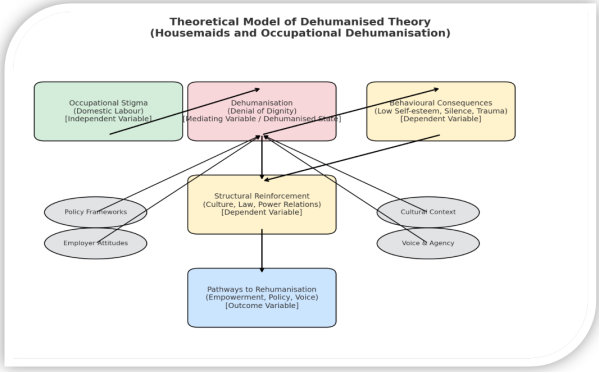
The theory posits that:
1) Occupational Stigma - Domestic labour is marked by systemic denial of dignity, equality, and recognition.
2) Behavioural Consequences - Dehumanisation produces low self-esteem, silence in abuse, and intergenerational psychological effects.
3) Structural Reinforcement - Cultural attitudes, legal gaps, and power imbalances institutionalise this dehumanised state.
4) Pathways to Rehumanisation - Empowerment, voice, and policy reform can restore dignity and transform the status of domestic workers.
Below is a model that clearly explains the advanced theory demonstrating its implication as seen in the dependent variables which tend to be reinforced by structural reinforcement
| [3] | Banda, S. and Mpolomoka, D. L. (2018). Culturally relevant education and training for communities: A review. African Educational Research Journal, 6(2), 88-93. |
| [24] | Mushibwe, C. P., Chambeshi, M. & Mpolomoka, D. L. (2021). Valuing Safehome Shelters for Victims of Violence in Lusaka Province, Zambia. Journal of African Interdisciplinary Studies, 5(9), 41 - 56. |
| [25] | Muasya, G. (2020). Stressors and work-family conflict among female teachers in urban public schools in Kenya. South African Journal of Education, 40(2), Article 1769. |
| [36] | Mushibwe. C. P. (2014). What are the Effects of Cultural Traditions on the Education of women? (The Study of the Tumbuka People of Zambia) [Paperback] Anchor Academic ISBN Book: 978-3-95489-097-2. Druck/Herstellung: Anchor Publishing. Hamburg. (aap_verlag). |
[3, 24, 25, 36]
. The positive implication lies in the outcome variables that include empowerment, good laws and giving the maids a voice to speak to their situation for sustainable improvement.
| [19] | Klemm, B.; Dauble, W.; Beimin, W.; Lai, A.; Min, H., and Sinha, S., (2011). Protection for Domestic Workers - Challenges and Prospects. Briefing Paper Shanghai Special Issue. |
| [12] | International Labour Organization (ILO). (2011). Domestic Workers Convention, 2011 (No. 189). NORMLEX.
https://normlex.ilo.org/dyn/nrmlx_en/f?p=NORMLEXPUB:12100:0::NO::P12100_ILO_CODE:C189 |
| [13] | International Labour Organization (ILO). (2024). Labour Rights and Social Protection Coverage for Domestic Workers in ASEAN.
https://www.ilo.org/sites/default/files/2024-10/Labour_RightsSocial_Protection_Coverage_for_Domestic_Workers_in_ASEAN%20_REPORT.pdf |
| [7] | Chanda, C., & Banda, F. (2025). The Paradox of Minimum Wage: Exploring Its Effects on the Economic Welfare of Domestic Workers in Zambia. International Journal of Research and Innovation in Social Science (IJRISS). |
| [26] | Ngambi, S. N., Mpolomoka, D. L., Chikopela, R. & Mushibwe, C. (2023). Counseling Practices that Promote Behaviour Change: A Case of Drug and Alcohol Dependent Youths in Lusaka, Zambia. Research in Psychology and Behavioral Sciences, 11(1), 28-38. https://doi.org/10.12691/rpbs-11-1-5 |
| [32] | Sovon, S. I,. (2021). Protection of Domestic Workers: Need for Law. University of Asia Pacific. |
[19, 12, 13, 7, 26, 32]
.
Figure 1. The Theoretical Model of Dehumanised Theory.
Complementing this framework, Power Dynamics Theory explains how employer-employee relations enable mistreatment through control of labour, autonomy, and emotions. Intersectionality Theory highlights how gender and class combine to compound the vulnerability of mostly poor, uneducated women. Social Reproduction Theory underscores the undervaluation of domestic labour, which sustains social and gender hierarchies while rendering maids’ contributions invisible
| [7] | Chanda, C., & Banda, F. (2025). The Paradox of Minimum Wage: Exploring Its Effects on the Economic Welfare of Domestic Workers in Zambia. International Journal of Research and Innovation in Social Science (IJRISS). |
| [32] | Sovon, S. I,. (2021). Protection of Domestic Workers: Need for Law. University of Asia Pacific. |
[7, 32]
.
While Dehumanised Theory serves as the primary framework for this study, offering critical insights into how domestic workers are systematically marginalized and dehumanized, the integration of Power Dynamics Theory, Intersectionality Theory, and Social Reproduction Theory provides a more comprehensive understanding of the structural, cultural, and gendered forces that contribute to the oppression of maids. Together, these theories demonstrate how systemic power relations, gendered and class-based inequalities, and cultural norms intersect to perpetuate the dehumanization of domestic workers. However, Dehumanised Theory remains central to the analysis, emphasizing that the key driver of exploitation and marginalization in domestic labour is the denial of personhood and recognition based on the occupational choices of maids. This research calls for a paradigm shift in how society perceives domestic work, advocating for greater recognition of the human dignity of maids, empowerment, and institutional reforms that ensure the rights and wellbeing of domestic workers are safeguarded
| [6] | Bryceson, D. F. (2019). Domestic Work. In S. Bellucci & A. Eckert (Eds.), General Labour History of Africa: Workers, Employers and Governments, 20th-21st Centuries (pp. 301-332). James Currey / Cambridge University Press. |
| [7] | Chanda, C., & Banda, F. (2025). The Paradox of Minimum Wage: Exploring Its Effects on the Economic Welfare of Domestic Workers in Zambia. International Journal of Research and Innovation in Social Science (IJRISS). |
| [32] | Sovon, S. I,. (2021). Protection of Domestic Workers: Need for Law. University of Asia Pacific. |
| [28] | Prakasam, S., (2021). Employment and living conditions of domestic workers in India Available at:
https://www.researchgate.net/publication/355927224 |
| [33] | Statutory Instrument No. 49 of 2023. The Minimum Wages and Conditions of Employment (Domestic Workers) Order, 2023. Government of Zambia. |
[6, 7, 32, 28, 33]
.
3. Methodology
This research is firmly rooted in an exploratory epistemological orientation that aligns with an interpretivist approach. The chosen research design is qualitative, specifically adopting a naturalistic inquiry method, with the aim of gaining a profound understanding of social phenomena as they naturally occur within the context of the participants. This approach was employed to capture the meanings and experiences as perceived by the participants in their everyday lives.
The qualitative design was selected due to its inherent flexibility and open-ended nature, which facilitated the collection of comprehensive data through one-to-one interviews, focus group interviews, and conversations from a total of 45 participants. The study involved a purposive sampling method, followed by a snowballing technique, which enabled the researcher to intentionally identify and include households that employed maids as participants in the interviews. In addition to interviews, the researcher took deliberate steps to visit various households in different areas of Lusaka, allowing for the direct observation of the dynamics and relationships between housemaids and their employers. Thematic analysis served as the chosen method for analyzing the collected narrative data. This approach provided a structured framework for identifying, examining, and interpreting recurring themes and patterns within the data, contributing to a deeper understanding of the research subject.
Given the sensitivity nature of the subject, strict ethical conventions were observed throughout the research process. Informed consent was obtained from all participants, prior the interviews with assurances of confidentiality and anonymity to protect vulnerable housemaids from reprisals by employers. Hence, no name of any house maid interviewed, the household, or the location has been named in this document. Interviews were conducted in safe, private settings to minimize risks of emotional harm and exploitation. Participants narrations involving physical, emotional, or sexual abuse, were referred to support networks. However, of all the participants non accepted reference to the available networks on grounds that they are never heard. Participants’ autonomy and dignity were respected, with the right to withdraw at any stage without consequence.
4. Findings
This section presents the results from the data collected through interviews with 45 participants: 20 maids, 20 employers, and 5 husbands. These participants provided valuable perspectives on the working conditions, challenges, and relationships that shape the experiences of maids in Zambian households. The findings are categorized into key themes based on the different types of households, perceptions of domestic work, challenges faced by maids, and the employers' perspectives.
4.1. Working Patterns of Maids
1) Working for a Wealthy Couple with a Non-Working Wife: The maid is responsible for all household chores, childcare, and cooking, with little involvement from the wife.
2) Working for a Dual-Income Couple (Both Spouses Working): The maid takes on responsibilities including housework, childcare, and cooking, with both the husband and wife being employed full-time.
3) Working for a Dual-Income Couple (Live-In Maid): The maid is a live-in employee who may only return home on weekends or after long periods, especially if they come from rural areas.
4) Working for a Single Working Parent: In single-parent households, the maid assumes full responsibility for domestic chores and childcare, often in the absence of the other parent.
These categories underscore the diverse roles that maids play in different households, with varying expectations depending on the socio-economic context of the family
.
4.2. Perceptions of Maids and the Job
Employers' perceptions of maids were largely negative, with common stereotypes and biases influencing their treatment of domestic workers:
Laziness and Lack of Initiative: Employers often complained that maids lacked initiative and required constant supervision to complete basic tasks. Many expressed frustration over maids’ perceived "dumbness" and inability to act without explicit instruction. One employer in Household 10 shared:
These maids seem to emerge from the same mother. Their tendency to wait for instruction every day is unbelievable. Someone works up in the morning, goes for that one thing they do every day, cleaning the house. If I do not say, curtains need washing, they never be washed. Almost all the maids I have employed lack simple initiative. They are dumb and serious thinking is a worrying issue.
Household 1: Maid te muntu (bemba name to mean that a maid is not human). She started.
Aba abantu, ni ma devils (these human beings). I have no kind words to describe them. I have had a bitter share of them. I need a maid but getting a good one is like looking for a needle in a haystack. The poem about Finnish women underscores this contradiction: the maid is indispensable yet remains unappreciated
| [8] | Finnish Domestics in Canada, 1911-30,” in Jean Burnet (ed.), Looking into My Sister’s Eyes: An Exploration in Women’s History (Toronto, 1986), 33-53, 34. |
[8]
.
Potential for Destructive Behaviour: Some employers were concerned about maids’ potential for mismanaging household items or even stealing, particularly in households with valuable assets. For example, Household 2 commented:
I have been unlucky with maids. The ones I employ are thieves. I have a pantry in my bedroom. Every morning, I have to leave daily rations. A bit of salt, a bit of cooking oil, a bit of sugar etc. If I forget, everything goes. That is not good. If they are thieves, they are liars. No truth comes from them.”
The behavior of such a maid aligns with what Mushibwe and Ntanisha observed: their disengagement not only makes them unhappy at work but also leads to visible expressions of frustration, with their unhappiness often manifesting in overt actions for all to see
| [24] | Mushibwe, C. P., Chambeshi, M. & Mpolomoka, D. L. (2021). Valuing Safehome Shelters for Victims of Violence in Lusaka Province, Zambia. Journal of African Interdisciplinary Studies, 5(9), 41 - 56. |
[24]
.
Perceived Unproductiveness: Employers viewed the maids’ work as intentionally unproductive, often attributing perceived laziness to personal failings, rather than understanding the structural conditions of their work environment. Household 15 shared:
These are girls and women who should automatically know household chores. I usually ask, ‘Bana Bwalya (the maid’s name), you don’t wash, or cook chicken in your home?’ The answer is yes. So why should the one you cook here be like this? No answer. Some of the maids I have had are total failures. They failed at school and this they continue to demonstrate even in a simple job. This one working for me is the 20th in 8 years.
4.3. Challenges Faced by Maids
Maids reported facing multiple challenges, both in their working environment and from their employers:
Lack of Trust and Victimization: Several maids described being unfairly accused of theft or other forms of misconduct, despite no evidence to support such claims. These accusations led to humiliating punishments and sometimes the loss of their jobs. Maid 20, for instance, shared:
I was locked up for almost the whole day (8 hours on the balcony with a 2.5-liter container as my toilet). My employer said I would steal her things and eat her food if I was left in the house. How did I leave that place? I saw the oldest son steal money. When the madam asked who had taken the money, I expressed ignorance. I did not want to be involved. But I was accused as the thief. In the presence of the son who stole the money. So, I was told to leave or they take me to the police station. I had been threatened a number of times with the police.
Maid 30 narrated,
I like my job, I know, it’s just a maid, but I do it with my whole heart, the more I try my best the worse my relationship with my boss. I have even approached saying “madam, please guide me and help me to know what you want”. Nothing comes from her except complaint after complaint. I have heard her so many times telling her friends that ndi wacibeleshi (I have familiarity problems), and can steal her husband. This is simply because I ask her questions so I don’t do what she doesn’t want.
Physical and Emotional Abuse: Stories of physical abuse and verbal mistreatment were shared, including instances of being beaten, humiliated, and blamed for problems in the household. Maid 2 recounted:
I have been ill-treated. This madam literally pulled hair off my head because when ironing, I burnt her dress. The iron they have is not these common irons. I can read and so I didn’t know the iron was too hot for the dress. She spat on my face and my salary was cut. She said she needed to replace the dress. I begged and begged because tuition fees for my child were supposed to be paid and she refused.
Maid 1 stated:
The first day I reported at work, I was given a gift of roll on. Madam explained that it was going to help remove the bad odour I carried with me. The days that followed, she kept on complaining that the air in the house was contaminated because of me. I don’t know how many times I bathed in a day to remove the odour she claimed I carried. After just about two weeks I stopped.
This has been clearly been noted by different authors
| [1] | Asha D’Souza (2010). Moving towards Decent work for Domestic workers: An Overview of the ILO’s work. ISBN 978-92-2-122050-3 (print) ISBN 978-92-2-122051-0 (web pdf) https://www.ilo.org/sites/default/files/wcmsp5/groups/public/@dgreports/@gender/documents/publication/wcms_142905.pdf |
| [15] | Jureidini, R., (2014) “The Use and Abuse of Domestic Workers: case studies in Lebanon and Egypt”, In Wenona Giles, Mary Romero and Valerie Preston (eds) When Care Work Goes Global: Locating the Social Relations of Domestic Work, Ashgate. |
| [17] | Kelman, H. C. (1973). Violence Without Moral Restraint: Reflections on the Dehumanization of Victims and Victimizers. Journal of Social Issues, 29(4), 25-61. |
| [22] | Mpolomoka, D. L., Mushibwe, C., Dube, D., Musonda, M., Sumbwa, P., Mabenga, M. M. and Kanduza, K. (2019). Community Reflections on Intergenerational Sexual Relations in Solwezi District. Texila International Journal of Academic Research. Special Edition, 110-123.
https://doi.org/10.21522/TIJAR.2014.SE.19.01.Art012 |
| [29] | Smt. Sandhya S. J., (2019). A study on socio-economic status of house maid workers in Karnataka: A Sociological Study. International Journal of Management Studies and Social Science Research. IJMSSSR 2019 VOLUME 1 ISSUE 6 NOVEMBER - DECEMBER ISSN: 2582-0265/ Avai. |
[1, 15, 17, 22, 29]
and further confirms dehumanization and finally resulting into a dehumanized state as indicated in the theory advanced here.
Low Wages and Inhumane Working Conditions: Many maids described their wages as inadequate, sometimes paid late, and highlighted the heavy workloads, including long hours with little to no rest. Maid 4 shared her struggles:
I work all day and go to bed at 23 hours. I have to wake up at 6 am. If I am found sitting, I am in trouble and I am threatened. I sleep in the same bedroom with the only daughter, but mine is the floor. There are no beddings. I use wrappers. I was told not to bring my own beddings just in case we have lice and can transfer them to the house. I don’t get paid well. And I am not the only one. Maybe all of us here. I am sometimes paid after two months or so late, like on the 15th of the month instead of the 30th or the 31st.”
Maid 45:
I have worked for 18 years as a maid and the highest I have received is K500. This is K500 was an increase after working for them for all these years. I wake up at 4pm to be able to walk 6 kilometres. I have to be at work for 7:30 before madam leaves. I can’t leave until Madam arrives. She has to search me and my bag before I leave. I have made up my mind a number of times to just stop but, my daughter is at university now. I can’t leave. If she gets a job, I will leave.
Maid 32 contributing to low wages concern stated:
I am paid every day. How much she arrives at what she pays me, I don’t even understand. It frustrates and disadvantaging me completely. I have complained but she doesn’t even hear me.
While ILO’s Convention No. 189 (C189) advocates for decent work for domestic workers, calling for legal recognition, rights, and protection, a number of maids continue struggling under poor conditions of work.
| [30] | Smith, D. L. (2011). Less Than Human: Why We Demean, Enslave, and Exterminate Others. New York: St. Martin’s Press. |
| [33] | Statutory Instrument No. 49 of 2023. The Minimum Wages and Conditions of Employment (Domestic Workers) Order, 2023. Government of Zambia. |
| [35] | Zimbardo, P. (2007). The Lucifer Effect: Understanding How Good People Turn Evil. New York: Random House. |
[30, 33, 35]
.
Maid 35 explained:
I have worked for 10 years and I have never gone on leave. I work as a live-in maid and I see my husband and children on Sunday only. If I am ill, I am asked to go back home and I do not get paid for those days. My husband can’t work because he is disabled, so I have to work.
Such conditions of work are a clear demonstration of dehumanisation. This is as a result of the absence of formal contracts, social protection, and recognition under Labour laws places domestic workers at a significant disadvantage, making it difficult for them to assert their rights or seek justice in cases of exploitation or abuse
| [4] | Bernstein, D. (1988) "The subcontracting of cleaning work in Israel: a case in the casualization of Labour", in R. E. Pahl (ed.) On Work. Historical Comparative & Theoretical Approaches, Oxford: Basil Blackwell, pp. 392- 406. |
| [6] | Bryceson, D. F. (2019). Domestic Work. In S. Bellucci & A. Eckert (Eds.), General Labour History of Africa: Workers, Employers and Governments, 20th-21st Centuries (pp. 301-332). James Currey / Cambridge University Press. |
| [7] | Chanda, C., & Banda, F. (2025). The Paradox of Minimum Wage: Exploring Its Effects on the Economic Welfare of Domestic Workers in Zambia. International Journal of Research and Innovation in Social Science (IJRISS). |
| [32] | Sovon, S. I,. (2021). Protection of Domestic Workers: Need for Law. University of Asia Pacific. |
| [28] | Prakasam, S., (2021). Employment and living conditions of domestic workers in India Available at:
https://www.researchgate.net/publication/355927224 |
| [33] | Statutory Instrument No. 49 of 2023. The Minimum Wages and Conditions of Employment (Domestic Workers) Order, 2023. Government of Zambia. |
| [16] | Kapembwa, L., & Mulenga, M. (2023). The Extent to Which the Minimum Wage and Conditions of Employment Act (Cap 276) is Being Implemented and Its Impact on the Living Conditions of Domestic Workers in Kitwe, Zambia. Available on ResearchGate. |
| [29] | Smt. Sandhya S. J., (2019). A study on socio-economic status of house maid workers in Karnataka: A Sociological Study. International Journal of Management Studies and Social Science Research. IJMSSSR 2019 VOLUME 1 ISSUE 6 NOVEMBER - DECEMBER ISSN: 2582-0265/ Avai. |
[4, 6, 7, 32, 28, 33, 16, 29]
.
4.4. Emotional and Psychological Strain
The maids also faced emotional challenges, such as isolation, discrimination, and a sense of inferiority stemming from their lower educational and social status. Maid 9 shared a heart-breaking story:
The madam I work for is very good. I cannot complain about her. She pays me well and treats me like her sister. The husband is the problem. He forces himself on me. He even broke the door to my bedroom just to have sex with me. He gave me some money to keep the secret. My child is now 3 years old. I would have left but for the madam, that is why I still work there.
Given the sensitive nature of the response of this participant, she was strongly advised to report the case to the police or the Victims unit in the country so that the issue can be solved. Unfortunately, she refused as she is afraid of losing the job ans later failing to look after the child. She is so sure the man will refuse and that will destroy her relationship with the “madam” in charge.
| [3] | Banda, S. and Mpolomoka, D. L. (2018). Culturally relevant education and training for communities: A review. African Educational Research Journal, 6(2), 88-93. |
| [24] | Mushibwe, C. P., Chambeshi, M. & Mpolomoka, D. L. (2021). Valuing Safehome Shelters for Victims of Violence in Lusaka Province, Zambia. Journal of African Interdisciplinary Studies, 5(9), 41 - 56. |
| [26] | Ngambi, S. N., Mpolomoka, D. L., Chikopela, R. & Mushibwe, C. (2023). Counseling Practices that Promote Behaviour Change: A Case of Drug and Alcohol Dependent Youths in Lusaka, Zambia. Research in Psychology and Behavioral Sciences, 11(1), 28-38. https://doi.org/10.12691/rpbs-11-1-5 |
| [29] | Smt. Sandhya S. J., (2019). A study on socio-economic status of house maid workers in Karnataka: A Sociological Study. International Journal of Management Studies and Social Science Research. IJMSSSR 2019 VOLUME 1 ISSUE 6 NOVEMBER - DECEMBER ISSN: 2582-0265/ Avai. |
[3, 24, 26, 29]
. The following was her response:
Madam, addressing the interviewer, if I report to the police, they will not believe me. They can even lock me up. Many of my friends talk about this but we don’t report it. It is just that I have a child with the man. It is difficulty. Even the same organizations you are talking about, it is difficulty. They will be asking so many questions. And who am I? I am a nobody. Am just a maid. No one will believe me. It will be ‘maids are like this, she planned it, she just wanted to destroy the marriage.’ I can’t do it.
In a book called “The dirty Secrets: An Expose of Zambia's Unspoken Cultural Skeletons,” the authors explain how such cases of abuse go without reporting for fear of blame put on the victim
| [36] | Mushibwe. C. P. (2014). What are the Effects of Cultural Traditions on the Education of women? (The Study of the Tumbuka People of Zambia) [Paperback] Anchor Academic ISBN Book: 978-3-95489-097-2. Druck/Herstellung: Anchor Publishing. Hamburg. (aap_verlag). |
[36]
others include
| [22] | Mpolomoka, D. L., Mushibwe, C., Dube, D., Musonda, M., Sumbwa, P., Mabenga, M. M. and Kanduza, K. (2019). Community Reflections on Intergenerational Sexual Relations in Solwezi District. Texila International Journal of Academic Research. Special Edition, 110-123.
https://doi.org/10.21522/TIJAR.2014.SE.19.01.Art012 |
| [17] | Kelman, H. C. (1973). Violence Without Moral Restraint: Reflections on the Dehumanization of Victims and Victimizers. Journal of Social Issues, 29(4), 25-61. |
| [30] | Smith, D. L. (2011). Less Than Human: Why We Demean, Enslave, and Exterminate Others. New York: St. Martin’s Press. |
[22, 17, 30]
.
5. Discussions
Dehumanisation theory posits that individuals or groups denied recognition as fully human are subjected to mistreatment, marginalization, and exploitation. Drawing from Kelman
| [18] | Kelman, H. C. (1976). The Policy Context of Torture: A Social-Psychological Analysis. International Review of the Red Cross, 16(157), 26-34. |
[18]
, Haslam
| [19] | Klemm, B.; Dauble, W.; Beimin, W.; Lai, A.; Min, H., and Sinha, S., (2011). Protection for Domestic Workers - Challenges and Prospects. Briefing Paper Shanghai Special Issue. |
[19]
, Zimbardo
| [35] | Zimbardo, P. (2007). The Lucifer Effect: Understanding How Good People Turn Evil. New York: Random House. |
[35]
, and Smith
| [30] | Smith, D. L. (2011). Less Than Human: Why We Demean, Enslave, and Exterminate Others. New York: St. Martin’s Press. |
[30]
, the theory explains how violence, neglect, and abuse become normalised when others are seen as “less than human.” This study advances the Dehumanised Theory by contextualizing these insights within the occupational domain of domestic Labour. Here, housemaids are devalued not due to ethnicity or ideology, but because of the nature of their work, which renders them voiceless and invisible
| [28] | Prakasam, S., (2021). Employment and living conditions of domestic workers in India Available at:
https://www.researchgate.net/publication/355927224 |
| [17] | Kelman, H. C. (1973). Violence Without Moral Restraint: Reflections on the Dehumanization of Victims and Victimizers. Journal of Social Issues, 29(4), 25-61. |
| [18] | Kelman, H. C. (1976). The Policy Context of Torture: A Social-Psychological Analysis. International Review of the Red Cross, 16(157), 26-34. |
[28, 17, 18]
.
5.1. Lack of Initiative and Perceived “Dumbness”
The stereotype that maids are lazy or incapable of independent thought exemplifies animalistic dehumanisation. Employers’ perceptions that maids lack initiative deny them autonomy and intelligence, reducing them to objects of Labour. Household 10’s employer remarked:
These maids seem to emerge from the same mother... They are dumb and serious thinking is a worrying issue. This reflects the occupational stigma of Dehumanised Theory, whereby domestic work itself becomes associated with diminished human worth. The absence of training or skill development reinforces this dehumanisation, implying that maids are destined for menial tasks without growth or recognition. Such a trend is sad as the demand for house helpers is as a result of increasing numbers of women working and improving their lifestyles as noted by Prakasam
| [19] | Klemm, B.; Dauble, W.; Beimin, W.; Lai, A.; Min, H., and Sinha, S., (2011). Protection for Domestic Workers - Challenges and Prospects. Briefing Paper Shanghai Special Issue. |
| [17] | Kelman, H. C. (1973). Violence Without Moral Restraint: Reflections on the Dehumanization of Victims and Victimizers. Journal of Social Issues, 29(4), 25-61. |
| [15] | Jureidini, R., (2014) “The Use and Abuse of Domestic Workers: case studies in Lebanon and Egypt”, In Wenona Giles, Mary Romero and Valerie Preston (eds) When Care Work Goes Global: Locating the Social Relations of Domestic Work, Ashgate. |
| [28] | Prakasam, S., (2021). Employment and living conditions of domestic workers in India Available at:
https://www.researchgate.net/publication/355927224 |
| [3] | Banda, S. and Mpolomoka, D. L. (2018). Culturally relevant education and training for communities: A review. African Educational Research Journal, 6(2), 88-93. |
| [24] | Mushibwe, C. P., Chambeshi, M. & Mpolomoka, D. L. (2021). Valuing Safehome Shelters for Victims of Violence in Lusaka Province, Zambia. Journal of African Interdisciplinary Studies, 5(9), 41 - 56. |
[19, 17, 15, 28, 3, 24]
.
The idea that maids are deliberately unproductive represents mechanistic dehumanisation, where workers are valued only for output and treated as faulty machines when they fail to meet unrealistic expectations. Household 15 expressed:
These are girls and women who should automatically know household chores... No answer.” Such attitudes strip domestic workers of individuality and context, ignoring systemic barriers like lack of training or cultural unfamiliarity with household technologies. This supports Dehumanised Theory’s claim that occupational choice itself is the basis for denial of dignity and equality
| [28] | Prakasam, S., (2021). Employment and living conditions of domestic workers in India Available at:
https://www.researchgate.net/publication/355927224 |
| [20] | Lundberg, H. R (nd) Modern Maids: A Study of Au Pairs as 'Gap Year' Domestic Workers. |
| [3] | Banda, S. and Mpolomoka, D. L. (2018). Culturally relevant education and training for communities: A review. African Educational Research Journal, 6(2), 88-93. |
| [15] | Jureidini, R., (2014) “The Use and Abuse of Domestic Workers: case studies in Lebanon and Egypt”, In Wenona Giles, Mary Romero and Valerie Preston (eds) When Care Work Goes Global: Locating the Social Relations of Domestic Work, Ashgate. |
| [2] | Banda, B. M., (2018). Maids Training Curriculum and Infant Care in Lusaka Urban, Zambia. International Journal of Humanities and Social Science Vol. 8 No. 4 April 2018 |
| [26] | Ngambi, S. N., Mpolomoka, D. L., Chikopela, R. & Mushibwe, C. (2023). Counseling Practices that Promote Behaviour Change: A Case of Drug and Alcohol Dependent Youths in Lusaka, Zambia. Research in Psychology and Behavioral Sciences, 11(1), 28-38. https://doi.org/10.12691/rpbs-11-1-5 |
[28, 20, 3, 15, 2, 26]
.
5.2. Emotional and Physical Abuse
Cases of maids being locked up, accused of theft, or humiliated highlight how dehumanisation translates into objectification. When workers are denied personhood, their emotions and rights become invisible. Abuse reflects the structural reinforcement described by Dehumanised Theory: cultural attitudes and employer-employee power imbalances institutionalise this Dehumanised state. This echoes Kelman’s notion of moral exclusion, where mistreatment is rationalised as acceptable
| [17] | Kelman, H. C. (1973). Violence Without Moral Restraint: Reflections on the Dehumanization of Victims and Victimizers. Journal of Social Issues, 29(4), 25-61. |
| [28] | Prakasam, S., (2021). Employment and living conditions of domestic workers in India Available at:
https://www.researchgate.net/publication/355927224 |
| [33] | Statutory Instrument No. 49 of 2023. The Minimum Wages and Conditions of Employment (Domestic Workers) Order, 2023. Government of Zambia. |
[17, 28, 33]
.
By integrating Dehumanisation Theory with the Dehumanised Theory, this study demonstrates that domestic workers are Dehumanised not because of ethnicity, race, or wartime ideologies, but because of their occupational identity. The theory contributes to knowledge by reframing domestic Labour as a site of systemic silencing and disempowerment. It highlights the need for pathways to rehumanisation through empowerment, recognition, and policy reform, affirming that the dignity of housemaids must be safeguarded if social justice and equality are to be realised.
5.3. Critical Discussion Using Power and Intersectionality Theory
Power and intersectionality theory explores how different layers of identity, including race, gender, class, and education, intersect to create specific power dynamics that shape individuals' lived experiences. This lens is crucial in understanding the structural and relational dimensions of domestic labour
| [6] | Bryceson, D. F. (2019). Domestic Work. In S. Bellucci & A. Eckert (Eds.), General Labour History of Africa: Workers, Employers and Governments, 20th-21st Centuries (pp. 301-332). James Currey / Cambridge University Press. |
| [7] | Chanda, C., & Banda, F. (2025). The Paradox of Minimum Wage: Exploring Its Effects on the Economic Welfare of Domestic Workers in Zambia. International Journal of Research and Innovation in Social Science (IJRISS). |
| [32] | Sovon, S. I,. (2021). Protection of Domestic Workers: Need for Law. University of Asia Pacific. |
| [3] | Banda, S. and Mpolomoka, D. L. (2018). Culturally relevant education and training for communities: A review. African Educational Research Journal, 6(2), 88-93. |
| [24] | Mushibwe, C. P., Chambeshi, M. & Mpolomoka, D. L. (2021). Valuing Safehome Shelters for Victims of Violence in Lusaka Province, Zambia. Journal of African Interdisciplinary Studies, 5(9), 41 - 56. |
| [26] | Ngambi, S. N., Mpolomoka, D. L., Chikopela, R. & Mushibwe, C. (2023). Counseling Practices that Promote Behaviour Change: A Case of Drug and Alcohol Dependent Youths in Lusaka, Zambia. Research in Psychology and Behavioral Sciences, 11(1), 28-38. https://doi.org/10.12691/rpbs-11-1-5 |
[6, 7, 32, 3, 24, 26]
.
The experiences of maids are shaped by the intersection of gender, class, and education. As women from lower socio-economic backgrounds, many maids are vulnerable to exploitation because they are perceived as lower in status. The gendered nature of domestic work positions women in a subordinate role, reinforcing patriarchal power structures within the household. Additionally, the education gap between maids and their employers exacerbates these inequalities. Employers often assume that their maids should automatically know how to perform domestic tasks without considering the differences in upbringing, exposure, or skill level.
| [3] | Banda, S. and Mpolomoka, D. L. (2018). Culturally relevant education and training for communities: A review. African Educational Research Journal, 6(2), 88-93. |
| [24] | Mushibwe, C. P., Chambeshi, M. & Mpolomoka, D. L. (2021). Valuing Safehome Shelters for Victims of Violence in Lusaka Province, Zambia. Journal of African Interdisciplinary Studies, 5(9), 41 - 56. |
| [26] | Ngambi, S. N., Mpolomoka, D. L., Chikopela, R. & Mushibwe, C. (2023). Counseling Practices that Promote Behaviour Change: A Case of Drug and Alcohol Dependent Youths in Lusaka, Zambia. Research in Psychology and Behavioral Sciences, 11(1), 28-38. https://doi.org/10.12691/rpbs-11-1-5 |
| [27] | Odeku, O. K., (2014). An Overview of Domestic Work Phenomenon. Mediterranean Journal of Social Sciences. MCSER Publishing, Rome-Italy. Vol 5 No 9 May 2014.
https://doi.org/10.5901/mjss.2014.v5n9p697 |
| [34] | Tremblay, D.-G. (2015). Work-Life Integration and Workplace Rights for Domestic Workers in Support to Elderly Persons: A Real Challenge in a Complex Working Environment. SAGE Open, 5(2). https://doi.org/10.1177/2158244015584236 |
[3, 24, 26, 27, 34]
.
The employers’ sense of superiority over the maids is a clear manifestation of power imbalances. Employers see themselves as having the right to enforce authority through commands, punishment, or even sexual coercion, as seen in the case of Maid 9, who was raped by her employer’s husband. This abuse of power reflects a broader social order that allows certain individuals to dominate and exploit others due to the socio-economic divide. The maids unengaged employees and are marginalized and excluded from decision-making processes, a process that perpetuates their dependency and reinforces the cycle of abuse and exploitation
| [27] | Odeku, O. K., (2014). An Overview of Domestic Work Phenomenon. Mediterranean Journal of Social Sciences. MCSER Publishing, Rome-Italy. Vol 5 No 9 May 2014.
https://doi.org/10.5901/mjss.2014.v5n9p697 |
| [34] | Tremblay, D.-G. (2015). Work-Life Integration and Workplace Rights for Domestic Workers in Support to Elderly Persons: A Real Challenge in a Complex Working Environment. SAGE Open, 5(2). https://doi.org/10.1177/2158244015584236 |
| [37] | Mushibwe, C. P., and Mushibwe, M. Z. (2024). Dirty Secrets: An Expose of Zambia’s Unspoken Cultural Skeletons. ASIN: B0DPB4WKXC Publisher: Notion Press. |
[27, 34, 37]
.
Intersectionality explains how maids internalize their marginalized position. Maid 2’s story of retaliation, including sabotaging the children of her employer, reflects a rebellion against the power dynamics that dehumanize her. However, such acts are a form of resistance through suffering, where the maid's lower status and lack of alternatives drive her to retaliate in harmful ways, reinforcing the toxic cycle of abuse. Similarly, the narration of Maid 4’s resentment towards her employer’s treatment of her highlights how maids’ emotional and physical labour is exploited while their humanity is constantly undermined. Employers, particularly those who employ live-in maids, expect them to seamlessly blend into the family structure and provide care for children, often without any regard for the emotional toll it takes on the maid. Employers also expect maids to respect boundaries, though these boundaries are frequently arbitrary and shaped by the employer’s sense of control. The poem about Finnish women underscores a contradiction: the maid is indispensable yet remains unappreciated. The employers’ treatment of maids, as evidenced in Household 13, reveals how power dynamics within the home are influenced by perceptions of familiarity, control, and ownership, often at the expense of the maid's dignity
| [6] | Bryceson, D. F. (2019). Domestic Work. In S. Bellucci & A. Eckert (Eds.), General Labour History of Africa: Workers, Employers and Governments, 20th-21st Centuries (pp. 301-332). James Currey / Cambridge University Press. |
| [7] | Chanda, C., & Banda, F. (2025). The Paradox of Minimum Wage: Exploring Its Effects on the Economic Welfare of Domestic Workers in Zambia. International Journal of Research and Innovation in Social Science (IJRISS). |
| [8] | Finnish Domestics in Canada, 1911-30,” in Jean Burnet (ed.), Looking into My Sister’s Eyes: An Exploration in Women’s History (Toronto, 1986), 33-53, 34. |
| [9] | Gargi, P. R (2009). An investigation into poverty among domestic maids in Lusaka, Zambia Available at:
https://core.ac.uk/download/pdf/6681118.pdf |
| [10] | Haslam, N. (2006). Dehumanization: An Integrative Review. Personality and Social Psychology Review, 10(3), 252-264. |
| [32] | Sovon, S. I,. (2021). Protection of Domestic Workers: Need for Law. University of Asia Pacific. |
| [29] | Smt. Sandhya S. J., (2019). A study on socio-economic status of house maid workers in Karnataka: A Sociological Study. International Journal of Management Studies and Social Science Research. IJMSSSR 2019 VOLUME 1 ISSUE 6 NOVEMBER - DECEMBER ISSN: 2582-0265/ Avai. |
[6-10, 32, 29]
.
6. Conclusion
This study has explored the role of housemaids and the challenges they face within their profession, particularly focusing on the reasons why this profession is often devalued. The findings from this research demonstrate a range of factors that contribute to the negative perceptions surrounding housemaids and their work. Established are the societal views that tend to reduce the role of housemaids to one of servitude, neglecting the skills, labour, and emotional labour required for their tasks. Additionally, challenges such as low wages, lack of job security, and limited professional recognition exacerbate the dehumanization of domestic workers, creating a cycle of undervaluation.
From the perspective of employers, while some recognize the critical role housemaids play in maintaining the household, others often view the profession as less skilled or important, reflecting broader societal biases that associate domestic work with gender and class inequalities. These perceptions are further compounded by legal and structural challenges that limit the rights and protections afforded to housemaids in many countries.
The research has successfully answered the research questions by:
1) Identifying the prevailing perceptions about housemaids, which are largely shaped by historical and cultural factors that emphasize their subordinate role in society.
2) Highlighting the key challenges housemaids face, including poor working conditions, lack of legal protection, and social stigmatization.
3) Understanding the challenges employers face in managing domestic workers, including communication barriers, a lack of formal employment structures, and a general lack of recognition of the professional nature of the work.
Ultimately, the findings suggest that the devaluation of housemaids is a multifaceted issue involving societal, economic, and cultural dimensions. While efforts are being made in some regions to improve conditions and recognize the contributions of domestic workers, there is still significant work to be done to challenge deeply ingrained biases and improve the working conditions for housemaids. The contribution of the Dehumanised Theory demonstrated how an occupational domain of domestic labour, where housemaids are rendered “less than human” not because of ethnicity, war, or ideology, but because of the choice of the job they perform can be dehumanized. By theorising the experiences of housemaids as a process of occupational dehumanisation, this framework extends the field of dehumanisation studies into everyday labour and family contexts. It contributes to knowledge by highlighting how structural inequalities and cultural stigmas intersect with the most intimate spaces of society—the household—to produce systemic silencing and disempowerment.
Therefore, this research has concluded that the research questions and the objective of understanding the reasons behind the devaluation of housemaids and their profession have been met. The study has provided valuable insights that can inform policies and initiatives aimed at improving the rights and recognition of domestic workers worldwide. Human wellbeing should be a universal right, not determined by the job one holds.
Below are the recommendations suggested to improve the plight of the house helpers.
7. Recommendations
1) Establish Registered Training Schools for Housemaids under TEVETA
a) Action: The government should work with the Technical Education, Vocational and Entrepreneurship Training Authority (TEVETA) to establish registered training schools specifically for housemaids. These would provide accredited courses that align with the needs of modern households and equip domestic workers with essential skills in areas such as childcare, cleaning, cooking, and household management.
| [3] | Banda, S. and Mpolomoka, D. L. (2018). Culturally relevant education and training for communities: A review. African Educational Research Journal, 6(2), 88-93. |
| [20] | Lundberg, H. R (nd) Modern Maids: A Study of Au Pairs as 'Gap Year' Domestic Workers. |
| [24] | Mushibwe, C. P., Chambeshi, M. & Mpolomoka, D. L. (2021). Valuing Safehome Shelters for Victims of Violence in Lusaka Province, Zambia. Journal of African Interdisciplinary Studies, 5(9), 41 - 56. |
| [26] | Ngambi, S. N., Mpolomoka, D. L., Chikopela, R. & Mushibwe, C. (2023). Counseling Practices that Promote Behaviour Change: A Case of Drug and Alcohol Dependent Youths in Lusaka, Zambia. Research in Psychology and Behavioral Sciences, 11(1), 28-38. https://doi.org/10.12691/rpbs-11-1-5 |
| [29] | Smt. Sandhya S. J., (2019). A study on socio-economic status of house maid workers in Karnataka: A Sociological Study. International Journal of Management Studies and Social Science Research. IJMSSSR 2019 VOLUME 1 ISSUE 6 NOVEMBER - DECEMBER ISSN: 2582-0265/ Avai. |
[3, 20, 24, 26, 29]
.
b) Rationale: By integrating housemaid training within a formal, recognized framework, TEVETA can ensure that the skills being taught meet the standards of the industry and address the evolving demands of domestic work. This professionalization would raise the status of housemaids, improve their employability, and empower them socially and economically. Furthermore, the evaluation and accreditation of training curricula by TEVETA would ensure that housemaids receive relevant and comprehensive education, increasing their chances of career advancement and protection within the labour market.
| [6] | Bryceson, D. F. (2019). Domestic Work. In S. Bellucci & A. Eckert (Eds.), General Labour History of Africa: Workers, Employers and Governments, 20th-21st Centuries (pp. 301-332). James Currey / Cambridge University Press. |
| [7] | Chanda, C., & Banda, F. (2025). The Paradox of Minimum Wage: Exploring Its Effects on the Economic Welfare of Domestic Workers in Zambia. International Journal of Research and Innovation in Social Science (IJRISS). |
| [32] | Sovon, S. I,. (2021). Protection of Domestic Workers: Need for Law. University of Asia Pacific. |
| [3] | Banda, S. and Mpolomoka, D. L. (2018). Culturally relevant education and training for communities: A review. African Educational Research Journal, 6(2), 88-93. |
| [24] | Mushibwe, C. P., Chambeshi, M. & Mpolomoka, D. L. (2021). Valuing Safehome Shelters for Victims of Violence in Lusaka Province, Zambia. Journal of African Interdisciplinary Studies, 5(9), 41 - 56. |
| [26] | Ngambi, S. N., Mpolomoka, D. L., Chikopela, R. & Mushibwe, C. (2023). Counseling Practices that Promote Behaviour Change: A Case of Drug and Alcohol Dependent Youths in Lusaka, Zambia. Research in Psychology and Behavioral Sciences, 11(1), 28-38. https://doi.org/10.12691/rpbs-11-1-5 |
[6, 7, 32, 3, 24, 26]
.
2) Strengthen Reporting Mechanisms for Abuse with Mobile-Friendly Systems
a) Action: Government authorities, NGOs, and tech developers should collaborate to develop and implement mobile-friendly abuse reporting systems. These platforms should provide housemaids with a secure, accessible, and anonymous way to report instances of mistreatment, exploitation, or abuse. Additionally, the government should support advocacy initiatives, including random home visits by trained staff or volunteer teams, to check on the welfare of domestic workers and verify reports of abuse.
b)
Rationale: Strengthening these reporting mechanisms would give housemaids an easy and confidential way to seek help when needed, enhancing their protection. Mobile platforms are crucial for reaching housemaids who may not have access to other reporting channels, and integrating outreach programs ensures that government and support organizations can actively intervene in households where abuse is reported. Regular random visits or advocacy clinics can help identify and address issues proactively, reducing the risk of unreported abuse
.
3) Offer Protection for Untrained Housemaids Without Access to Formal Training
a) Action: The government, along with labour unions and NGOs, should implement protective measures for housemaids who have not undergone formal training. Legal frameworks should be developed to enforce labour protections specifically for domestic workers, regardless of their training status. This includes creating accessible complaint mechanisms, offering social services support, and ensuring legal protections against exploitation and abuse
| [6] | Bryceson, D. F. (2019). Domestic Work. In S. Bellucci & A. Eckert (Eds.), General Labour History of Africa: Workers, Employers and Governments, 20th-21st Centuries (pp. 301-332). James Currey / Cambridge University Press. |
| [7] | Chanda, C., & Banda, F. (2025). The Paradox of Minimum Wage: Exploring Its Effects on the Economic Welfare of Domestic Workers in Zambia. International Journal of Research and Innovation in Social Science (IJRISS). |
| [32] | Sovon, S. I,. (2021). Protection of Domestic Workers: Need for Law. University of Asia Pacific. |
| [30] | Smith, D. L. (2011). Less Than Human: Why We Demean, Enslave, and Exterminate Others. New York: St. Martin’s Press. |
| [33] | Statutory Instrument No. 49 of 2023. The Minimum Wages and Conditions of Employment (Domestic Workers) Order, 2023. Government of Zambia. |
| [3] | Banda, S. and Mpolomoka, D. L. (2018). Culturally relevant education and training for communities: A review. African Educational Research Journal, 6(2), 88-93. |
| [24] | Mushibwe, C. P., Chambeshi, M. & Mpolomoka, D. L. (2021). Valuing Safehome Shelters for Victims of Violence in Lusaka Province, Zambia. Journal of African Interdisciplinary Studies, 5(9), 41 - 56. |
| [26] | Ngambi, S. N., Mpolomoka, D. L., Chikopela, R. & Mushibwe, C. (2023). Counseling Practices that Promote Behaviour Change: A Case of Drug and Alcohol Dependent Youths in Lusaka, Zambia. Research in Psychology and Behavioral Sciences, 11(1), 28-38. https://doi.org/10.12691/rpbs-11-1-5 |
[6, 7, 32, 30, 33, 3, 24, 26]
.
b) Rationale: By extending labour protections to all domestic workers, including those without formal training, the government ensures that all housemaids have the right to a safe and dignified working environment. Strengthening labour laws that apply to domestic workers will provide a safety net for those at risk of abuse or exploitation, regardless of their educational background. Providing access to legal recourse, social services, and support for untrained housemaids will help close the gap in protection and promote fairness in the workforce
| [6] | Bryceson, D. F. (2019). Domestic Work. In S. Bellucci & A. Eckert (Eds.), General Labour History of Africa: Workers, Employers and Governments, 20th-21st Centuries (pp. 301-332). James Currey / Cambridge University Press. |
| [7] | Chanda, C., & Banda, F. (2025). The Paradox of Minimum Wage: Exploring Its Effects on the Economic Welfare of Domestic Workers in Zambia. International Journal of Research and Innovation in Social Science (IJRISS). |
| [32] | Sovon, S. I,. (2021). Protection of Domestic Workers: Need for Law. University of Asia Pacific. |
| [30] | Smith, D. L. (2011). Less Than Human: Why We Demean, Enslave, and Exterminate Others. New York: St. Martin’s Press. |
| [33] | Statutory Instrument No. 49 of 2023. The Minimum Wages and Conditions of Employment (Domestic Workers) Order, 2023. Government of Zambia. |
| [3] | Banda, S. and Mpolomoka, D. L. (2018). Culturally relevant education and training for communities: A review. African Educational Research Journal, 6(2), 88-93. |
| [24] | Mushibwe, C. P., Chambeshi, M. & Mpolomoka, D. L. (2021). Valuing Safehome Shelters for Victims of Violence in Lusaka Province, Zambia. Journal of African Interdisciplinary Studies, 5(9), 41 - 56. |
| [26] | Ngambi, S. N., Mpolomoka, D. L., Chikopela, R. & Mushibwe, C. (2023). Counseling Practices that Promote Behaviour Change: A Case of Drug and Alcohol Dependent Youths in Lusaka, Zambia. Research in Psychology and Behavioral Sciences, 11(1), 28-38. https://doi.org/10.12691/rpbs-11-1-5 |
[6, 7, 32, 30, 33, 3, 24, 26]
.
4) Encourage Employers to Provide Written Contracts for Domestic Workers
a) Action: Employers, labour regulators, and advocacy organizations should collaborate to promote the widespread use of written contracts for domestic workers. Public awareness campaigns should be launched to educate employers about the importance of written agreements, and standardized contract templates should be made readily available for both parties. Employers should be encouraged—or legally required—to provide contracts that clearly outline terms of employment, including wages, working hours, job responsibilities, and termination procedures
| [6] | Bryceson, D. F. (2019). Domestic Work. In S. Bellucci & A. Eckert (Eds.), General Labour History of Africa: Workers, Employers and Governments, 20th-21st Centuries (pp. 301-332). James Currey / Cambridge University Press. |
| [7] | Chanda, C., & Banda, F. (2025). The Paradox of Minimum Wage: Exploring Its Effects on the Economic Welfare of Domestic Workers in Zambia. International Journal of Research and Innovation in Social Science (IJRISS). |
| [32] | Sovon, S. I,. (2021). Protection of Domestic Workers: Need for Law. University of Asia Pacific. |
| [30] | Smith, D. L. (2011). Less Than Human: Why We Demean, Enslave, and Exterminate Others. New York: St. Martin’s Press. |
| [33] | Statutory Instrument No. 49 of 2023. The Minimum Wages and Conditions of Employment (Domestic Workers) Order, 2023. Government of Zambia. |
[6, 7, 32, 30, 33]
.
b) Rationale: Written contracts are essential for protecting the rights of both domestic workers and employers. These agreements help clarify expectations, reduce misunderstandings, and provide a legal framework for resolving disputes. For housemaids, having a clear, written contract ensures that they understand their rights and responsibilities, thus reducing the likelihood of abuse or exploitation. The standardization of contracts across the domestic work sector will also help elevate the status of the profession by professionalizing the relationship between employer and employee
| [30] | Smith, D. L. (2011). Less Than Human: Why We Demean, Enslave, and Exterminate Others. New York: St. Martin’s Press. |
| [33] | Statutory Instrument No. 49 of 2023. The Minimum Wages and Conditions of Employment (Domestic Workers) Order, 2023. Government of Zambia. |
[30, 33]
.
Recommendation for Further Research
Future research should delve deeper into the psychological and emotional toll of domestic work on housemaids, particularly focusing on how the devaluation of the profession affects their mental health, self-esteem, and social relationships. This can include investigating long-term effects on both housemaids and their families, as well as how such emotional labour is often overlooked in existing studies. While physical and legal challenges of domestic work have been well-studied, the emotional and psychological impacts are less understood. Research in this area could provide more comprehensive support systems for housemaids, ensuring their well-being and highlighting the need for mental health support within this profession.
Abbreviations
Acronym | Full Meaning |
TEVETA | Technical Education, Vocational and Entrepreneurship Training Authority |
ILO | International Labour Organization |
Author Contributions
Christine Phiri Mushibwe: Conceptualization, Funding acquisition, Investigation, Project administration, Supervision, Visualization, Writing – original draft, Writing – review & editing
Daniel Lupiya Mpolomoka: Data curation, Formal Analysis, Funding acquisition, Investigation, Resources, Visualization, Writing – review & editing
Conflicts of Interest
The authors declare no conflicts of interest.
References
| [1] |
Asha D’Souza (2010). Moving towards Decent work for Domestic workers: An Overview of the ILO’s work. ISBN 978-92-2-122050-3 (print) ISBN 978-92-2-122051-0 (web pdf)
https://www.ilo.org/sites/default/files/wcmsp5/groups/public/@dgreports/@gender/documents/publication/wcms_142905.pdf
|
| [2] |
Banda, B. M., (2018). Maids Training Curriculum and Infant Care in Lusaka Urban, Zambia. International Journal of Humanities and Social Science Vol. 8 No. 4 April 2018
|
| [3] |
Banda, S. and Mpolomoka, D. L. (2018). Culturally relevant education and training for communities: A review. African Educational Research Journal, 6(2), 88-93.
|
| [4] |
Bernstein, D. (1988) "The subcontracting of cleaning work in Israel: a case in the casualization of Labour", in R. E. Pahl (ed.) On Work. Historical Comparative & Theoretical Approaches, Oxford: Basil Blackwell, pp. 392- 406.
|
| [5] |
Bino, P.; Datta, S., and Murthy, V., (2018). Working and Living Conditions of Women Domestic Workers: Insights from a Survey. The Indian Journal of Industrial Relations, Vol. 53, No. 3, January 2018
|
| [6] |
Bryceson, D. F. (2019). Domestic Work. In S. Bellucci & A. Eckert (Eds.), General Labour History of Africa: Workers, Employers and Governments, 20th-21st Centuries (pp. 301-332). James Currey / Cambridge University Press.
|
| [7] |
Chanda, C., & Banda, F. (2025). The Paradox of Minimum Wage: Exploring Its Effects on the Economic Welfare of Domestic Workers in Zambia. International Journal of Research and Innovation in Social Science (IJRISS).
|
| [8] |
Finnish Domestics in Canada, 1911-30,” in Jean Burnet (ed.), Looking into My Sister’s Eyes: An Exploration in Women’s History (Toronto, 1986), 33-53, 34.
|
| [9] |
Gargi, P. R (2009). An investigation into poverty among domestic maids in Lusaka, Zambia Available at:
https://core.ac.uk/download/pdf/6681118.pdf
|
| [10] |
Haslam, N. (2006). Dehumanization: An Integrative Review. Personality and Social Psychology Review, 10(3), 252-264.
|
| [11] |
Hoerder, D. (2015). Historical Perspectives on Domestic and Care-Giving Workers’ Migrations: A Global Approach. In E. van Nederveen Meerkerk, S. Neunsinger & D. Hoerder (Eds.), Towards a Global History of Domestic and Caregiving Workers (pp. 61-109). Leiden/Boston: Brill.
https://doi.org/10.1163/9789004280144_004
|
| [12] |
International Labour Organization (ILO). (2011). Domestic Workers Convention, 2011 (No. 189). NORMLEX.
https://normlex.ilo.org/dyn/nrmlx_en/f?p=NORMLEXPUB:12100:0::NO::P12100_ILO_CODE:C189
|
| [13] |
International Labour Organization (ILO). (2024). Labour Rights and Social Protection Coverage for Domestic Workers in ASEAN.
https://www.ilo.org/sites/default/files/2024-10/Labour_RightsSocial_Protection_Coverage_for_Domestic_Workers_in_ASEAN%20_REPORT.pdf
|
| [14] |
Jennings, K. (2013). The history of maids. Hankering for History. Retrieved from
http://hankeringforhistory.com/the-history-of-maids/
|
| [15] |
Jureidini, R., (2014) “The Use and Abuse of Domestic Workers: case studies in Lebanon and Egypt”, In Wenona Giles, Mary Romero and Valerie Preston (eds) When Care Work Goes Global: Locating the Social Relations of Domestic Work, Ashgate.
|
| [16] |
Kapembwa, L., & Mulenga, M. (2023). The Extent to Which the Minimum Wage and Conditions of Employment Act (Cap 276) is Being Implemented and Its Impact on the Living Conditions of Domestic Workers in Kitwe, Zambia. Available on ResearchGate.
|
| [17] |
Kelman, H. C. (1973). Violence Without Moral Restraint: Reflections on the Dehumanization of Victims and Victimizers. Journal of Social Issues, 29(4), 25-61.
|
| [18] |
Kelman, H. C. (1976). The Policy Context of Torture: A Social-Psychological Analysis. International Review of the Red Cross, 16(157), 26-34.
|
| [19] |
Klemm, B.; Dauble, W.; Beimin, W.; Lai, A.; Min, H., and Sinha, S., (2011). Protection for Domestic Workers - Challenges and Prospects. Briefing Paper Shanghai Special Issue.
|
| [20] |
Lundberg, H. R (nd) Modern Maids: A Study of Au Pairs as 'Gap Year' Domestic Workers.
|
| [21] |
Meerkerk E. van Nederveen, Neunsinger, S. and Hoerder, D. (2015). Domestic Workers of the World: Histories of Domestic Work as Global Labor History In: Towards a Global History of Domestic and Caregiving Workers. Pages: 1-24.
https://doi.org/10.1163/9789004280144_002
|
| [22] |
Mpolomoka, D. L., Mushibwe, C., Dube, D., Musonda, M., Sumbwa, P., Mabenga, M. M. and Kanduza, K. (2019). Community Reflections on Intergenerational Sexual Relations in Solwezi District. Texila International Journal of Academic Research. Special Edition, 110-123.
https://doi.org/10.21522/TIJAR.2014.SE.19.01.Art012
|
| [23] |
Mushibwe C. P., and Ntanisha, M, M., (2020). Followers: A Key Variable in Organisational Success. GRIN Verlag ISBN: 9783346277510:
https://www.grin.com/document/937497
|
| [24] |
Mushibwe, C. P., Chambeshi, M. & Mpolomoka, D. L. (2021). Valuing Safehome Shelters for Victims of Violence in Lusaka Province, Zambia. Journal of African Interdisciplinary Studies, 5(9), 41 - 56.
|
| [25] |
Muasya, G. (2020). Stressors and work-family conflict among female teachers in urban public schools in Kenya. South African Journal of Education, 40(2), Article 1769.
|
| [26] |
Ngambi, S. N., Mpolomoka, D. L., Chikopela, R. & Mushibwe, C. (2023). Counseling Practices that Promote Behaviour Change: A Case of Drug and Alcohol Dependent Youths in Lusaka, Zambia. Research in Psychology and Behavioral Sciences, 11(1), 28-38.
https://doi.org/10.12691/rpbs-11-1-5
|
| [27] |
Odeku, O. K., (2014). An Overview of Domestic Work Phenomenon. Mediterranean Journal of Social Sciences. MCSER Publishing, Rome-Italy. Vol 5 No 9 May 2014.
https://doi.org/10.5901/mjss.2014.v5n9p697
|
| [28] |
Prakasam, S., (2021). Employment and living conditions of domestic workers in India Available at:
https://www.researchgate.net/publication/355927224
|
| [29] |
Smt. Sandhya S. J., (2019). A study on socio-economic status of house maid workers in Karnataka: A Sociological Study. International Journal of Management Studies and Social Science Research. IJMSSSR 2019 VOLUME 1 ISSUE 6 NOVEMBER - DECEMBER ISSN: 2582-0265/ Avai.
|
| [30] |
Smith, D. L. (2011). Less Than Human: Why We Demean, Enslave, and Exterminate Others. New York: St. Martin’s Press.
|
| [31] |
Soko, J. J. (2016). The influence of househelps on child behaviour. Tangaza University College.
|
| [32] |
Sovon, S. I,. (2021). Protection of Domestic Workers: Need for Law. University of Asia Pacific.
|
| [33] |
Statutory Instrument No. 49 of 2023. The Minimum Wages and Conditions of Employment (Domestic Workers) Order, 2023. Government of Zambia.
|
| [34] |
Tremblay, D.-G. (2015). Work-Life Integration and Workplace Rights for Domestic Workers in Support to Elderly Persons: A Real Challenge in a Complex Working Environment. SAGE Open, 5(2).
https://doi.org/10.1177/2158244015584236
|
| [35] |
Zimbardo, P. (2007). The Lucifer Effect: Understanding How Good People Turn Evil. New York: Random House.
|
| [36] |
Mushibwe. C. P. (2014). What are the Effects of Cultural Traditions on the Education of women? (The Study of the Tumbuka People of Zambia) [Paperback] Anchor Academic ISBN Book: 978-3-95489-097-2. Druck/Herstellung: Anchor Publishing. Hamburg. (aap_verlag).
|
| [37] |
Mushibwe, C. P., and Mushibwe, M. Z. (2024). Dirty Secrets: An Expose of Zambia’s Unspoken Cultural Skeletons. ASIN: B0DPB4WKXC Publisher: Notion Press.
|
Cite This Article
-
ACS Style
Mushibwe, C. P.; Mpolomoka, D. L. The Silenced Voices of House-maids: Dehumanized for the Choice of JOB, That I DO. Sci. Technol. Public Policy 2025, 9(2), 135-145. doi: 10.11648/j.stpp.20250902.17
 Copy
|
Copy
|
 Download
-
@article{10.11648/j.stpp.20250902.17,
  author = {Christine Phiri Mushibwe and Daniel Lupiya Mpolomoka},
  title = {The Silenced Voices of House-maids: Dehumanized for the Choice of JOB, That I DO},
  journal = {Science, Technology & Public Policy},
  volume = {9},
  number = {2},
  pages = {135-145},
  doi = {10.11648/j.stpp.20250902.17},
  url = {https://doi.org/10.11648/j.stpp.20250902.17},
  eprint = {https://article.sciencepublishinggroup.com/pdf/10.11648.j.stpp.20250902.17},
  abstract = {This study examined the lived experiences and perceptions surrounding housemaids in Lusaka Province, Zambia, using a qualitative interpretivist approach with 45 participants, including employers, spouses, and housemaids themselves. Findings reveal that housemaids are widely perceived as lacking initiative, unproductive, and burdensome, which aligns with entrenched occupational stigma. Narratives further exposed recurrent themes of dehumanisation, including low wages, absence of contracts, denial of career prospects, physical and emotional abuse, and sexual exploitation. Employers frequently reinforced negative stereotypes, while housemaids recounted enduring inhumane working conditions, mistrust, and social exclusion. The study advances the Dehumanised Theory, which grounds how domestic workers are devalued not due to ethnicity or ideology, but because of the job they perform, rendering them “less than human.” This study recommendes the formalisation and professionalisation of domestic work through accredited training under TEVETA, enforceable written contracts, mobile-friendly abuse reporting mechanisms, and the extension of legal protections to both trained and untrained housemaids. These measures would restore dignity, promote empowerment, and address systemic silencing within this occupational domain.},
 year = {2025}
}
Copy
|
Download
-
TY  - JOUR
T1  - The Silenced Voices of House-maids: Dehumanized for the Choice of JOB, That I DO
AU  - Christine Phiri Mushibwe
AU  - Daniel Lupiya Mpolomoka
Y1  - 2025/12/31
PY  - 2025
N1  - https://doi.org/10.11648/j.stpp.20250902.17
DO  - 10.11648/j.stpp.20250902.17
T2  - Science, Technology & Public Policy
JF  - Science, Technology & Public Policy
JO  - Science, Technology & Public Policy
SP  - 135
EP  - 145
PB  - Science Publishing Group
SN  - 2640-4621
UR  - https://doi.org/10.11648/j.stpp.20250902.17
AB  - This study examined the lived experiences and perceptions surrounding housemaids in Lusaka Province, Zambia, using a qualitative interpretivist approach with 45 participants, including employers, spouses, and housemaids themselves. Findings reveal that housemaids are widely perceived as lacking initiative, unproductive, and burdensome, which aligns with entrenched occupational stigma. Narratives further exposed recurrent themes of dehumanisation, including low wages, absence of contracts, denial of career prospects, physical and emotional abuse, and sexual exploitation. Employers frequently reinforced negative stereotypes, while housemaids recounted enduring inhumane working conditions, mistrust, and social exclusion. The study advances the Dehumanised Theory, which grounds how domestic workers are devalued not due to ethnicity or ideology, but because of the job they perform, rendering them “less than human.” This study recommendes the formalisation and professionalisation of domestic work through accredited training under TEVETA, enforceable written contracts, mobile-friendly abuse reporting mechanisms, and the extension of legal protections to both trained and untrained housemaids. These measures would restore dignity, promote empowerment, and address systemic silencing within this occupational domain.
VL  - 9
IS  - 2
ER  -
Copy
|
Download





 Share This Article
 Twitter
 Linked In
 Facebook